
Why Your Rental Car "Deposit" Just Ate £1,500 of Your Holiday Spending Money
You land at Málaga a little after 11pm. The kids are melting, the luggage carousel is doing its slow, cruel lap, and you've still got a 40-minute drive to the villa. You get to the rental desk, hand over your card for the "deposit," sign three things you don't read, and drive off into the dark.
Two days later you go to pay for lunch and your card is declined. You check the app. Your holiday fund — the money you'd carefully set aside for tapas, boat trips and ice creams — has a great big hole in it. £1,500, gone. Or at least, gone-ish.
Welcome to one of the most misunderstood, most infuriating parts of hiring a car: the deposit hold. It's not technically a charge. You'll probably get most of it back. But between "you'll probably get it back" and "you actually got it back" lies a fortnight of tightened budgets, declined cards, and a slow-burning sense that you've been quietly fleeced.
Here's exactly what's happening to your money, why summer is peak season for it, and — crucially — the one thing that decides whether that £1,500 comes home or not.
First, the bit nobody explains: a "hold" is not a "charge"
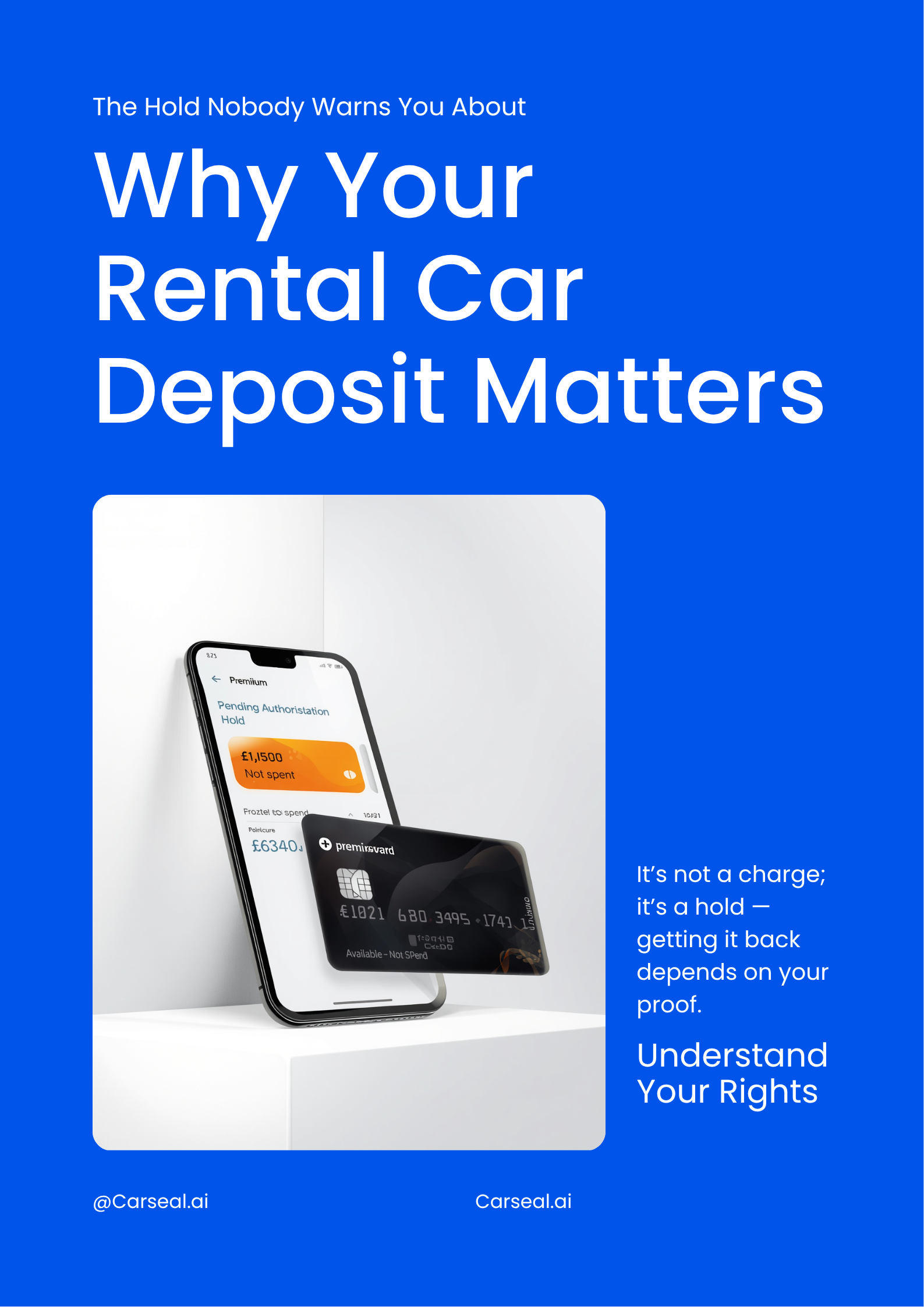
When you pick up a hire car, the company doesn't actually take your deposit. It places an authorisation hold (sometimes called a pre-authorisation or a "block") on your card. Your bank ring-fences that amount so you can't spend it, and hands it back to the rental company's control — pending.
Three things get muddled here constantly, so let's untangle them:
The hold (or deposit). A ring-fenced chunk of your available balance — often £1,000 to £2,000 — that the company can dip into if something goes wrong. It's not spent. It's frozen.
The excess. The maximum you pay if the car is damaged or stolen. Basic insurance is almost always included in the rental, but you're still on the hook for an excess, usually somewhere around £500 to £1,000, before that insurance does anything. If there's a scrape, the excess is what they take — often straight out of the hold.
The charge. An actual deduction. This is what a hold becomes if they decide you owe them for damage, fuel, cleaning, a missed toll, or an "administration fee."
The reason people feel scammed is that on a bank app, a hold and a charge can look almost identical — both show your money as gone. The difference is entirely about what happens next, and that depends on paperwork.
Why summer turns this from annoying into expensive
Peak season is when the whole system tilts against you, and it's not an accident of timing.
Landing late at Málaga, Alicante, Palma, Faro or Heraklion — with luggage, tired children and an onward drive still ahead — is precisely the moment you're least likely to read a rental contract properly or walk a slow, careful lap around the car with a torch. It's also the moment a scratch you didn't cause, an added insurance option you didn't want, or an unrecorded chip in the windscreen can quietly seed the bill that lands after you've flown home.
The volume makes it worse. Spain alone expects its rental channel to hit roughly 92,800 vehicle registrations across the May-to-September window, and the UK remains its single biggest source of visitors. Busy desks at peak flight times mean rushed handovers, queues behind you, and staff with every incentive to move you along fast.
And the pressure is real, not imagined. In one 2026 survey, 61% of people who bought insurance at the desk said they'd felt pressured into it — and Which? investigators who went undercover found that pressure selling, using bullying and lies, was an endemic problem across the industry. When you're jet-lagged and outnumbered at a counter, that's a deeply uneven negotiation.
The refund timeline nobody warns you about
Here's the part that actually eats your holiday.
Even in the best case — you return the car, everyone agrees there's no damage, and the hold is released — the money doesn't come back instantly. The rental company has to release it, and then your bank has to process that release. That round trip commonly takes several working days and can stretch past a week or two, especially over weekends and bank holidays.
So the sequence millions of British holidaymakers live through is:
Day one: £1,500 vanishes from your available balance.
The whole holiday: you're spending against what's left, not what you saved.
You fly home.
Somewhere in the following couple of weeks — if all goes well — the hold quietly releases.
If it doesn't all go well, the hold doesn't release. It converts. And now you're not waiting for your money; you're fighting for it.
The phantom scratch: where holds turn into charges
This is the flashpoint, and the stories are grimly consistent.
You pick the car up in the dark. You photograph the damage you can see. You return it, and on inspection they find a mark you don't have a clear photo of — a scuff on a wheel, a chip low on a bumper — and it comes straight out of your deposit. British renters describe this exact trap over and over: a scratch they're sure was already there, or couldn't possibly have caused, charged out of the hold before they've left the forecourt, with a threat to keep more of the deposit if they argue.
The insulting part is the maths. Say the repair is quoted at £400 and your excess is £1,000. You don't pay £400. You pay the £400, and you pay it out of your money, and you're left to claim it back — from a standalone excess policy if you had the foresight to buy one, or from the company itself if you're feeling brave.
And it's not only the small independents at obscure airports. Even the big names are now rolling out AI damage scanners — camera arches that photograph the car at pickup and drop-off and flag "damage" automatically. When they get it wrong, customers are the ones left proving a negative: one traveller was pursued for a four-figure repair bill flagged by a scanner, and was still being chased with threats of collections despite having evidence the scanner was mistaken.
Notice the common thread in every one of these stories. It is never really a dispute about whether a car is scratched. It's a dispute about who can prove the car's condition at a specific moment — and by default, that's not you.
The thing that decides everything: the burden of proof
Under UK civil law, if you dispute a damage charge, the burden of proof sits with the rental company. They have to show the damage happened during your rental and was caused by you. On paper, that's reassuring.
In practice, the burden lands wherever the evidence is. If they have a clean pickup inspection sheet and a photo of the "new" damage on return, and you have three blurry night-time snaps that don't quite show the relevant panel, then functionally the burden has shifted onto you — and you'll lose, or give up, which from their point of view is the same result.
Most of these disputes don't turn on the law at all. They turn on documentation. The renters who win are the ones who can produce timestamped proof of the car's exact state at handover and at return. The renters who pay are the ones who can't.
Which is the whole game. The difference between "I got my full deposit back" and "I'm £400 down and I'll never see it again" usually isn't luck, and it isn't how honest the desk staff were. It's whether, at the moment you took the keys, you captured proof solid enough that no one could invent a scratch afterwards — clear, complete, and stamped with a time and date you can't fake and they can't dispute.
Do that, and a phantom charge has nowhere to live. The hold stays a hold, releases on schedule, and your holiday fund is just your holiday fund.
Before you drive off the forecourt: a 90-second checklist
You don't need to be paranoid. You need to be quick and complete. Before you pull away:
Walk the whole car, slowly. Both bumpers, all four wheels and alloys, the roof, the windscreen and every window, the door edges, and the sills low down where scuffs hide.
Capture proof of the actual condition — every panel, close and clear, with a reliable timestamp — not just the two or three bits of damage you happen to spot. The gaps in your evidence are exactly where a phantom charge appears.
Get existing damage written down and signed. If there's a pickup sheet, make sure every mark you can see is on it, and keep your own copy. Verbal "oh, that's already noted" is worth nothing later.
Photograph the fuel gauge and the odometer. Fuel and mileage disputes are a whole separate genre of rip-off; don't hand them the opening.
Do it all again on return, before you hand the keys back, ideally with a member of staff present and agreeing there's no new damage.
Know what a hold is on your statement. If £1,500 disappears, check whether it says pending or authorisation. If it does, it's frozen, not spent — and your job now is simply to make sure it never converts.
The bottom line
The deposit hold isn't a scam in itself — it's a normal part of hiring a car, and most of the time you get your money back. The problem is the two weeks in between, and the small but real chance that a hold quietly turns into a charge you can't disprove.
You can't stop a company placing a hold. You can make sure it has no excuse to keep a penny of it. Ninety careful seconds when you pick the car up, and ninety more when you drop it off, is the cheapest travel insurance you'll ever buy — because the only thing standing between your £1,500 and someone else's repair invoice is proof. Get the proof, and your holiday money stays yours.