
Someone Hit Your Parked Rental Car? Who Pays and What to Do Next
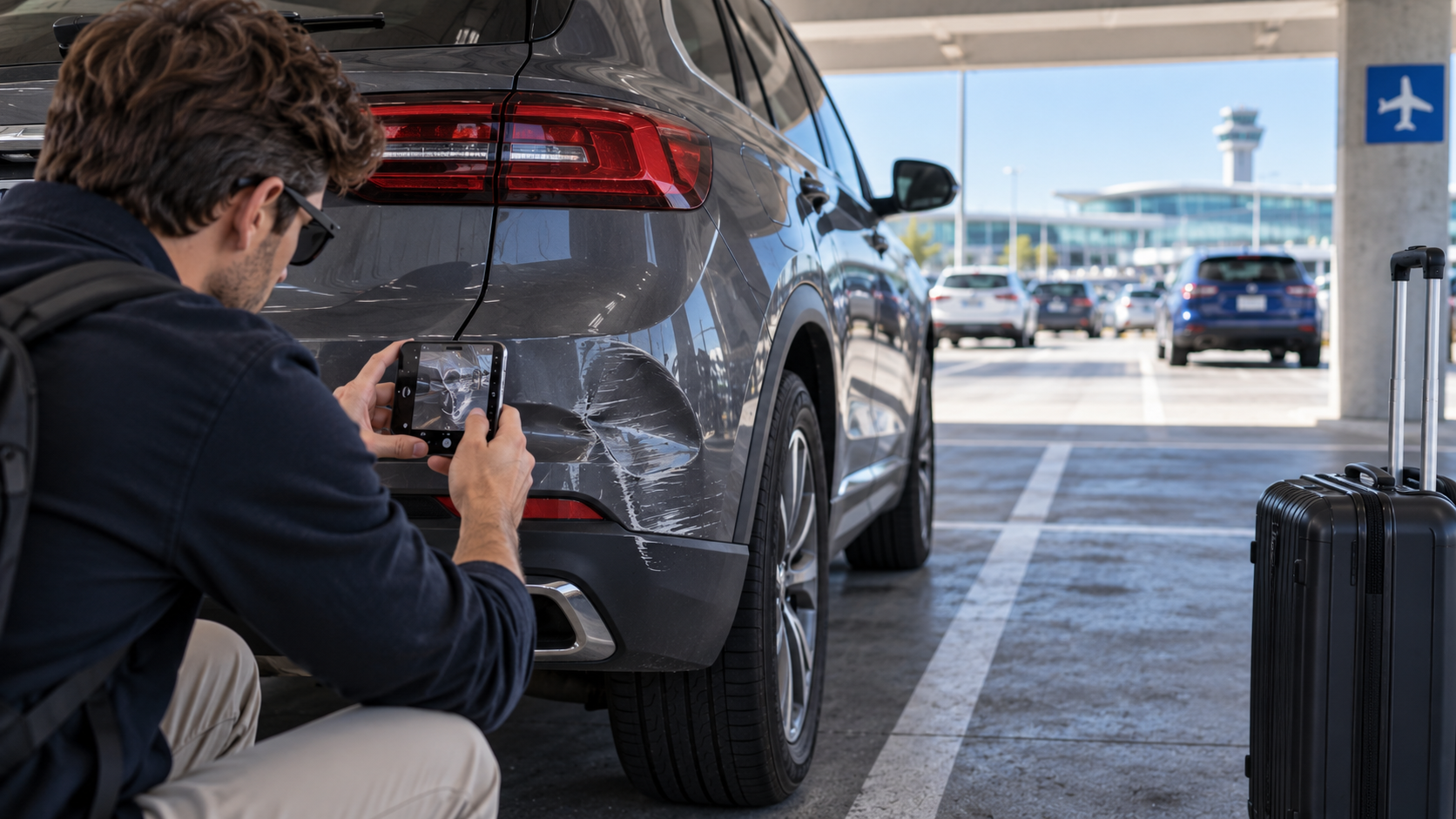
Someone Hit Your Parked Rental Car? Who Pays and What to Do Next
You come back to your rental car and discover a dent, scratch, or broken bumper. The other driver is nowhere to be found. Here's what happens next, who may be responsible, and how to protect yourself from an unexpected damage bill.
Imagine you're on holiday.
You've rented a car for the week, parked it outside a shopping center, and gone inside for lunch.
An hour later, you return to the parking lot.
Something looks different.
There's a fresh dent in the rear door and a long scrape across the bumper.
You look around for another driver. Nobody is there. There's no note on the windshield, no witnesses nearby, and no explanation for what happened.
You didn't cause the damage. You weren't even inside the vehicle.
But there's an uncomfortable question you suddenly need answered:
If someone hits your parked rental car, are you responsible for paying for the damage?
The answer isn't always what travelers expect.
Depending on your rental agreement, insurance coverage, and local laws, you could face an excess or deductible even when another driver caused the accident.
And if the person responsible disappears without leaving their details, recovering the cost can become much more complicated.
The good news is that knowing what to do immediately after discovering the damage can make a significant difference.
Who Pays if Someone Hits Your Parked Rental Car?
If someone hits your parked rental car, the person responsible or their insurer may ultimately have to cover the damage. However, your rental agreement can still make you financially responsible for certain costs while the claim is being resolved—even when the accident wasn't your fault.
The outcome generally depends on four factors:
Whether the other driver can be identified.
Whether you have rental car damage protection.
What your agreement says about deductibles and liability.
Whether the accident was reported and documented correctly.
For example, if another driver reverses into your rental car and provides their insurance information, the rental company may pursue recovery from that driver's insurer.
But if the driver leaves without providing any details, the process can become more complicated.
Some agreements may require you to pay an excess initially, subject to potential reimbursement later.
Others may provide broader protection, depending on the plan purchased.
It's important to understand that not being at fault doesn't always mean you won't receive a bill.
What to Do Immediately After Someone Hits Your Rental Car
If you discover damage while the vehicle is parked, follow these steps.
Step 1: Check Whether the Car Is Safe
Before investigating the financial implications, make sure the vehicle is safe.
Inspect the visible damage carefully.
A minor scratch on the door might be cosmetic, but a hard impact to the bumper or wheel could affect components you cannot see.
Look for obvious problems such as leaking fluids, damaged lights, a displaced bumper, a damaged wheel or tire, or a door that no longer closes correctly.
If the vehicle appears unsafe, don't drive it.
Contact the rental company's roadside assistance team and request instructions.
Even when a vehicle seems driveable, there may be hidden damage that requires professional inspection.
Step 2: Photograph the Damage Before Leaving
This is one of the most important steps.
Before moving the vehicle, where safe and legally permitted, take clear photographs of the damage and surrounding area.
Start with wider photographs showing the entire car.
Then capture close-ups of the damaged sections.
If the rear bumper is scratched, photograph the full bumper and the scratch itself.
Capture both the affected panel and its position on the vehicle.
Also photograph relevant surroundings:
The parking space and its markings.
Nearby signs or identifiable landmarks.
Any vehicle debris or broken components.
Visible paint transfer.
The position of the rental car.
Any note left by another driver.
These photographs can help explain what you discovered, where it happened, and the visible extent of the damage.
If the damage is later disputed, preserving the original files may be important.
Step 3: Look for Witnesses and Security Cameras
If the other driver has disappeared, check whether anyone witnessed the incident.
Parking attendants, security personnel, nearby drivers, and businesses may have useful information.
Many shopping centers, hotels, airports, and parking garages operate security cameras.
Ask the property manager whether footage might be available and whether they can preserve it for an official investigation.
You may not be entitled to receive the footage directly, depending on privacy laws and local procedures.
However, the police or insurer may be able to request it through the appropriate process.
Act promptly because surveillance footage may be overwritten after a retention period.
Step 4: Report the Accident to the Authorities
The reporting requirements depend on where the incident occurred.
Some jurisdictions require a police report for rental vehicle damage, even when the damage appears minor.
Elsewhere, requirements may depend on whether the other driver left the scene, someone was injured, or the property damage exceeds a particular threshold.
Contact the appropriate local authority and follow its instructions.
If you're renting in Dubai, for example, rental companies commonly require an official police report before processing collision-related insurance claims.
Minor incidents may be reportable through the Dubai Police app.
For serious emergencies, use the local emergency services.
Always follow the procedure relevant to your location rather than assuming the rules from your home country apply.
Step 5: Notify the Rental Company Immediately
Once everyone is safe and you've followed the required accident-reporting procedure, notify the rental company.
Don't wait until returning the vehicle several days later.
Explain what happened, where the car was parked, and whether the other driver has been identified.
Ask the company:
Whether an accident report must be completed.
What photographs or documentation it requires.
Whether you can continue using the car.
Whether a replacement vehicle is available.
How any insurance excess or deductible will be handled.
Record the incident reference number and keep copies of your communications.
For example, Enterprise's accident guidance instructs customers to contact the authorities and report the incident to its roadside assistance team.
The exact procedure differs between companies and rental locations.
Step 6: Contact the Relevant Insurance Provider
Depending on your booking, multiple forms of protection may be relevant.
These can include the rental company's damage waiver, your personal automobile insurance, a credit card rental benefit, or a third-party rental insurance policy.
However, not every policy covers every kind of incident.
Ask your insurer whether the accident qualifies for coverage and whether you need to file a claim within a particular timeframe.
You should also check whether the insurance covers loss-of-use charges, administrative fees, or any excess charged by the rental company.
Don't assume that having insurance means the entire claim will automatically be covered.
Step 7: Keep All Your Evidence
Store everything related to the incident in one place.
This should include:
Your original rental agreement.
Photographs taken at pickup.
Photographs of the new damage.
The police or incident report.
Witness details, where available.
Insurance and roadside assistance correspondence.
Communications with the rental company.
Repair estimates and any invoices.
A complete record helps you understand which costs are being claimed and what evidence supports them.
It may also make it easier to challenge a charge if the rental company later attributes unrelated or pre-existing damage to the same incident.
What Happens if Someone Hits Your Rental Car and Drives Away?
This is typically described as a hit-and-run.
For renters, it can be particularly stressful because the responsible driver may not be identifiable.
Without their identity, the rental company or insurer may have fewer options for recovering the repair cost directly from the person responsible.
Depending on the rental contract and protection plan, you may still face a deductible or excess.
This can feel unfair when you did absolutely nothing wrong.
But rental-car financial responsibility doesn't always follow the same rules as determining who caused an accident.
For example, Turo's damage claim guidance explains that guests may be responsible for eligible damage occurring during a trip even when they didn't cause it.
Traditional rental companies and car-sharing platforms can apply different terms.
That's why you should review the specific agreement that governs your booking.
If the other driver cannot be identified, preserve your evidence and follow the official reporting process.
You should not assume that the absence of another driver automatically makes you legally at fault.
What if the Other Driver Leaves a Note?
Finding a note with the other driver's contact details can make the process easier, but you still need to follow the proper procedure.
Photograph the note and keep the original.
Contact the driver if appropriate and obtain their insurer's details through the relevant reporting process.
If they acknowledge responsibility, preserve that communication.
However, don't assume that a private agreement to pay for repairs is sufficient.
Rental companies may require formal accident documentation, and unauthorized settlements or repairs may violate your agreement.
Even if the other driver offers to send you money immediately, contact the rental company before making arrangements.
If a police report is required, obtain one.
Does Rental Car Insurance Cover Parking Lot Damage?
Sometimes—but the details matter.
Different types of rental-car protection work in different ways.
Collision Damage Waiver or Loss Damage Waiver
A Collision Damage Waiver (CDW) or Loss Damage Waiver (LDW) may limit what you must pay for damage to the rental vehicle.
These products are not always traditional insurance policies.
Their coverage depends on the rental agreement, location, exclusions, and conditions.
Some may reduce your financial responsibility to a specified excess.
Others may remove it for eligible damage.
Failing to follow required accident-reporting procedures can affect protection.
Personal Car Insurance
Your own automobile insurance may extend certain coverage to rental vehicles, depending on your policy and the location of the rental.
However, international rentals, particular vehicle categories, and peer-to-peer car sharing may be excluded.
Contact your insurer rather than assuming coverage applies automatically.
Credit Card Rental Car Protection
Some credit cards provide rental vehicle damage coverage when eligible rentals are paid for with the card.
However, these benefits may be primary or secondary, and conditions differ.
You may need to decline certain rental-company protection products, use the eligible card, and report incidents within required deadlines.
Credit card coverage can also exclude specific countries, rental lengths, vehicle classes, or fees.
Third-Party Rental Insurance
Separate rental excess insurance policies may reimburse eligible charges you incur.
But the terms can include exclusions, claim documentation requirements, and maximum reimbursement limits.
The essential lesson is that you should understand your protection before an incident occurs, not after a damage invoice arrives.
How Much Could You Have to Pay?
There's no single figure.
The amount depends on the damaged components, repair requirements, contract, insurance, and local procedures.
For example, a minor bumper scrape may require a relatively simple cosmetic repair, while a substantial collision could involve sensors, brackets, or structural components.
Additional charges may also be considered under some contracts.
These could include administrative fees or loss-of-use charges, where legally and contractually permitted.
However, every charge should have an appropriate basis.
If an invoice seems excessive, ask for:
A detailed description of the damage.
Photographs showing the affected areas.
The repair estimate or relevant assessment.
An itemized breakdown of additional fees.
An explanation of how your protection or deductible applies.
Having a clear written record makes it easier to evaluate the claim.
The Problem Most Renters Discover Too Late
Here's a scenario that can make an already stressful situation much worse.
You rent a car and drive it for three days.
On the fourth day, someone backs into it while it's parked.
You report the incident and photograph the damaged rear bumper.
When the rental company evaluates the vehicle, however, it identifies scratches on another door as well.
You're told that these marks will be included in the damage claim.
But you're certain the door was already scratched when you collected the vehicle.
Unfortunately, you don't have a clear photograph of that side of the car at pickup.
Now you're dealing with two separate questions.
First: Who is responsible for the damage caused in the parking lot?
Second: Which damage was already present before the rental began?
Your accident photographs may help with the first question.
But without a reliable pickup record, proving the second can be difficult.
This is why documenting a rental car before driving away is so important.
You don't know what might happen during the trip.
And once damage has occurred, you cannot go back in time and capture the vehicle's original condition.
Why Before-and-After Rental Car Photos Matter
Good rental car documentation involves more than photographing a scratch after something has gone wrong.
Ideally, you should record the vehicle at three stages.
Before the Rental Begins
Photograph the car at pickup.
Capture the entire exterior, including doors, bumpers, wheels, mirrors, windshield, and other visible panels.
Take close-ups of existing marks.
Compare your photographs with the rental company's checkout report.
If something hasn't been documented, report it before leaving.
After an Incident
If another driver hits your parked rental car, record the new damage immediately when safe.
Photograph the affected area and its surroundings.
Retain the report number and incident details.
These materials create a record of what you observed after the accident.
Before Returning the Vehicle
At the end of the rental, photograph the vehicle again.
Pay particular attention to areas documented at pickup and to any new damage from the reported incident.
Retain the return receipt and other confirmation provided by the rental company.
Together, these three records help establish a clearer timeline.
They don't automatically determine responsibility, but they can make it easier to distinguish existing damage, incident-related damage, and the car's final condition.
Why Ordinary Phone Photos Can Be Difficult to Use in a Dispute
Taking photographs is an excellent starting point.
But consider what happens when a dispute begins weeks after your holiday.
The rental company asks for evidence of the car's original condition.
You open your phone gallery and start scrolling.
You find several pictures from the airport parking lot, but some are blurry.
Others show the wrong angle.
A screenshot you sent to a friend no longer includes the original metadata.
You also realize you never photographed the passenger-side door.
The issue isn't that you didn't have a camera.
It's that you didn't have a structured inspection process.
Even when original phone photos contain dates and location information, metadata may be editable or lost through sharing.
A stronger record combines consistent vehicle coverage, original preserved images, and information that helps establish when the record existed.
This is where dedicated rental car documentation tools can provide additional value.
How CarSeal Helps You Document Your Rental Car Before Problems Happen
CarSeal was designed for renters who want an independent record of their vehicle's condition.
Instead of relying on scattered photographs, CarSeal guides you through a structured exterior walk-around at pickup and return.
The goal is simple:
Document the car before someone questions what condition it was in.
Guided Vehicle Scanning
CarSeal helps you capture the exterior from multiple angles, including important areas such as bumpers, doors, wheels, and glass.
Required close-ups help create a more complete photographic record.
You can repeat the process at the end of your rental.
Tamper-Evident Evidence
CarSeal uses SHA-256 hashes and a sealed record to support verification that the uploaded photo record has not been changed.
A scan can also include an independent RFC-3161 timestamp token when available.
These technical features can help establish the integrity and existence of the recorded files.
They do not establish who caused a collision or independently prove that every photograph accurately represents the scene.
AI-Assisted Comparison
When you complete a return scan, CarSeal can help identify possible differences between photographed panels.
Its AI-assisted analysis highlights potential changes for review.
Like other AI systems, it can miss damage or produce incorrect findings.
You should always review the original photographs rather than treating automated results as a final determination.
Shareable Inspection Reports
CarSeal can generate a vehicle-condition report with a verification link.
This gives you a more organized way to present your documentation if a rental company questions whether a scratch was already present.
The verification feature checks the stored hash record. It does not determine legal responsibility or guarantee that a claim will be accepted.
If someone hits your rental car while it's parked, CarSeal cannot replace a police report, insurance, or an official accident investigation.
But your existing pickup record can help you distinguish what was already damaged before the incident from what you observed afterward.
And that can be extremely useful if several different marks end up included in a claim.
Your next rental deserves an independent condition record.
Get CarSeal for your next rental →
Learn more about how CarSeal's photographic evidence works.
What if Someone Hits Your Rental Car in Dubai?
Dubai has specific accident reporting procedures that visitors should understand.
If you discover that someone has damaged your parked rental car and disappeared, contact the appropriate authorities and follow the official process for an accident involving an unknown party.
The Dubai Police app supports certain accident-reporting services.
For serious accidents or emergencies, contact emergency services.
An official report is particularly important because rental companies and insurers commonly require it before handling accident-related claims.
A recent October 2026 report by Gulf News identified a fee of AED 420 for reporting a parked-car accident involving an unknown driver in Dubai. Check the current fee and reporting requirements through the official service before proceeding.
For a rental vehicle, notify the rental provider immediately.
Ask whether you need to submit the police report directly, whether you can continue using the vehicle, and how any insurance excess applies.
Don't arrange repairs independently unless the rental company has authorized them.
For more information, consult the Dubai Police official website.
How to Dispute a Parking Lot Damage Charge on a Rental Car
Sometimes the problem doesn't end when you report the accident.
You may receive a repair invoice that includes damage you don't recognize, additional fees, or a deductible you weren't expecting.
If that happens, start by reviewing your agreement and the incident report.
Ask the rental company for the photographs and damage assessment supporting the charges.
Compare them with your records from pickup, after the incident, and return.
If a mark was already visible before your rental, identify it clearly.
A well-organized explanation is more useful than simply insisting that the charge is unfair.
For example, you might explain:
"The rear bumper damage occurred during the reported parking-lot incident. However, the scratch on the passenger-side door was already present at vehicle pickup, as shown in the attached pickup photographs. I request that this pre-existing damage be excluded from the current claim."
Include supporting documents rather than relying on memory alone.
If the company rejects your dispute, request its reasons in writing and consider the available escalation procedures.
Depending on the location, these may involve the insurer, consumer protection authorities, alternative dispute resolution, or your card issuer.
You can also read how to prove pre-existing rental car damage.
Frequently Asked Questions
Am I liable if someone hits my parked rental car?
Possibly. Even if another driver caused the damage, your rental agreement may make you responsible for certain charges or an excess. The final financial outcome depends on the protection plan, insurance, applicable law, and whether the responsible driver can be identified.
What happens if someone hits my rental car and leaves?
Document the damage, preserve available evidence, report the incident to the appropriate authorities, and notify the rental company promptly. The insurer and rental provider will determine the applicable claim process.
Does rental car insurance cover hit-and-run damage?
It may. Coverage depends on the rental damage waiver or insurance policy, its exclusions, and reporting requirements. Some plans limit your financial responsibility, while others may leave you responsible for a deductible or additional costs.
Do I need a police report if someone hits my rental car?
It depends on local law and your rental agreement. Some jurisdictions and providers require an official report for even minor incidents. Always check the applicable requirements and report the event promptly.
Can I continue driving my rental car after someone hits it?
Only if it's safe and permitted by the rental company. Visible cosmetic damage doesn't always reveal hidden problems. If wheels, tires, lights, fluid systems, or structural components may be affected, request professional assistance before driving.
What if the other driver's insurance refuses to pay?
Review your rental agreement and applicable protection. You may have to work through the rental company's claims process or another eligible insurance policy while responsibility is resolved. Ask for written explanations of any amounts charged to you.
Can a rental company charge me for damage unrelated to the accident?
A company may allege additional damage, but you can request the evidence and challenge charges you believe are unsupported or relate to pre-existing marks. Pickup photographs and documented inspection reports can be important.
Can photos prove that rental car damage wasn't my fault?
Photographs can help establish the vehicle's visible condition before and after an incident, but they generally cannot prove who caused a collision on their own. Police reports, witness accounts, camera footage, and other records may also be necessary.
Is it worth using a rental car inspection app?
A guided inspection app can help you create a more consistent, organized photographic record at pickup and return. It's particularly useful when you want to preserve evidence of pre-existing damage before a future dispute.
Final Thoughts: You Can't Control Other Drivers, but You Can Control Your Evidence
Nobody rents a car expecting to return to a parking lot and discover a damaged bumper.
It can happen during a weekend getaway, a business trip, or an ordinary visit to a supermarket.
And when it happens, your first concern may be whether you'll have to pay for something you didn't cause.
The answer depends on the circumstances, your insurance, and your rental agreement.
But one thing remains within your control: how well you document the vehicle.
Photograph the car before driving away.
If an incident occurs, document the damage and follow the correct reporting process.
Photograph the car again at return.
Preserve the evidence.
Because if a disagreement arises weeks later, an organized record may be far more useful than trying to remember exactly what the vehicle looked like.
Their inspection. Your evidence.
Protect Your Next Rental With CarSeal
CarSeal helps you document your rental car at pickup and return with guided photographic scans, tamper-evident records, AI-assisted review, and shareable inspection reports.
Get CarSeal for your next rental →
CarSeal is an independent vehicle documentation tool and does not guarantee insurance coverage, reversal of a charge, or any legal outcome. This article provides general information, not legal or insurance advice. Requirements and policies vary by jurisdiction and provider.