
Rental Car Tire & Wheel Damage: Who Pays, and What Should You Check Before Driving?
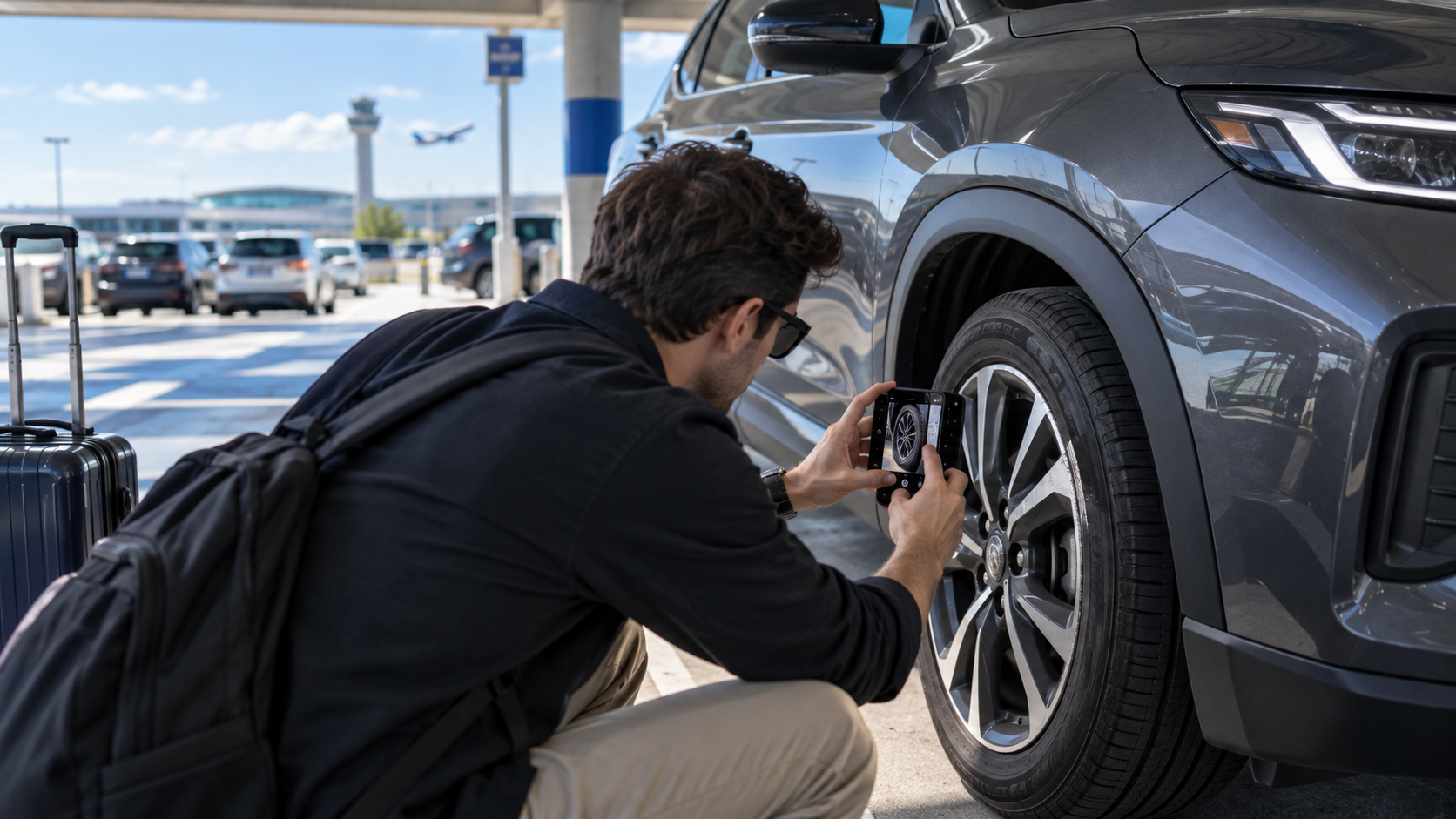
You've just landed after a long flight. Your rental car is waiting in the airport parking garage, your luggage is loaded, and you're ready to start your trip.
You walk around the vehicle, check for obvious scratches on the doors and bumpers, and get behind the wheel.
Everything looks fine.
Twenty minutes later, a warning appears on the dashboard.
Low Tire Pressure.
You pull into a gas station and discover that one tire is significantly underinflated.
Was the tire already damaged when you picked up the vehicle? Did you drive over something? Is it a slow puncture, a defective tire, or simply an inflation problem?
Suddenly, a routine car rental has turned into a stressful situation.
And there's another question you might not have considered: Who pays if the tire needs replacing?
Rental car tire and wheel damage is particularly complicated because the problem isn't always as straightforward as a visible scratch.
Some damage happens during a rental. Other problems may result from normal wear, inadequate maintenance, or existing defects.
Understanding the difference can matter for both your safety and your wallet.
Here's what every renter should know before driving away.
Why You Should Always Check Rental Car Tires Before Driving
Most travelers know they should inspect a rental car for scratches and dents.
But how many people carefully examine all four tires?
It's easy to overlook them.
At an airport rental counter, you're often focused on collecting the keys, checking the fuel policy, navigating an unfamiliar city, and getting on the road.
Tires rarely seem like something that deserves extra attention.
However, they're among the most important safety components on any vehicle.
A tire with dangerously low pressure, a damaged sidewall, or excessive tread wear can affect steering, braking, handling, and the risk of tire failure.
The National Highway Traffic Safety Administration (NHTSA) advises drivers to monitor tire pressure, tread condition, and signs of damage such as cuts, cracks, and bulges.
This advice applies just as much to a rental car as to your own vehicle.
The difference is that with a rental car, you often know very little about how the vehicle was maintained or driven before you received it.
You aren't expected to perform a professional mechanical inspection.
But a brief visual check can help identify obvious problems that deserve attention before you begin driving.
Who Pays for a Flat Tire on a Rental Car?
Responsibility for rental car tire damage depends on what caused the damage, your rental agreement, any protection plan, and applicable law.
There's no universal rule that makes the renter automatically responsible for every tire problem.
Consider three different situations.
Scenario 1: You Hit Something and Damage the Tire
Imagine driving over a sharp object, striking a curb, or hitting a pothole that causes tire damage.
If the damage occurred during your rental, you may be financially responsible, depending on your agreement and available protection.
Some rental protection packages exclude tires and wheels. Others may offer additional coverage.
It's important to check before assuming that collision damage protection automatically includes tire damage.
Scenario 2: The Tire Was Already Defective or Worn Out
Now imagine the tire fails because it was already excessively worn or had an existing defect.
That's a very different situation.
For example, Turo's published flat tire guidance distinguishes certain pre-existing tire problems from accidental damage during a trip.
Its host guidance identifies conditions including unsafe tread wear, existing sidewall damage, manufacturing defects, and improper inflation at the start of the rental as potential host responsibilities.
That doesn't establish how every case will be decided, and traditional rental companies have their own terms.
But it illustrates why determining the condition and cause of a tire failure matters.
Scenario 3: Nobody Knows Exactly What Happened
This is where things get complicated.
You notice a tire-pressure warning after driving for an hour.
You haven't hit any visible obstacles or experienced an obvious incident.
Was the tire already leaking? Did you pick up a nail? Was there a pre-existing defect you couldn't see?
Without an inspection record or professional diagnosis, the cause may be uncertain.
Photographs taken at pickup can help establish visible tire condition, but they cannot always identify internal defects, slow leaks, or mechanical problems.
That's why evidence and prompt reporting are both important.
Rental Car Wheel Damage: Why a Small Rim Scratch Can Be Expensive
Tire damage isn't the only concern.
The wheels themselves can become the subject of unexpected rental damage charges.
One particularly common type of cosmetic wheel damage is known as curb rash.
Curb rash occurs when the edge of a wheel scrapes against a curb or another hard surface.
It can leave visible scratches, scuffs, or gouges on the wheel's outer edge.
Sometimes the marks are relatively minor.
Other times the impact may be associated with more serious damage, including a bent or cracked wheel.
How Much Does Rental Car Rim Damage Cost?
There isn't a single standard price.
The amount can vary depending on:
The vehicle and wheel type.
The extent of the damage.
Whether repair or replacement is necessary.
The rental company's damage assessment policy.
Labor, administrative, and other contractual charges.
Your insurance or damage protection coverage.
A cosmetic scuff on a standard alloy wheel may be repairable.
A cracked or structurally damaged wheel may require replacement.
Luxury vehicles and specialized wheels can also involve higher parts and repair costs.
But an expensive invoice alone doesn't establish whether the proposed repair is necessary.
If you're charged for wheel damage, request an itemized assessment and photographs showing the affected area.
Check the rental agreement for any relevant wear-and-tear threshold.
And most importantly, compare the claim with photographs of the wheel taken when you collected the car.
Is Minor Curb Rash Considered Normal Wear and Tear?
It depends on the rental company and the applicable policy.
Some operators distinguish minor cosmetic marks from chargeable damage using published thresholds.
Others may assess wheel damage differently from bodywork damage.
Peer-to-peer car sharing platforms may also apply separate definitions.
For example, Turo's U.S. host earnings-plan documentation includes certain small exterior scratches, including some wheel and rim marks, within its definition of exterior wear and tear.
However, the treatment of a specific claim can depend on the booking, protection plan, damage type, location, and applicable terms.
Don't assume that every scratch is chargeable—or that every small scratch is exempt.
The best approach is to review the relevant policy and preserve clear before-and-after photographs.
The Rental Car Tire and Wheel Inspection Checklist
You don't need to be a mechanic to perform a useful visual inspection.
Before leaving the rental location, give yourself a few extra minutes to examine the vehicle.
1. Inspect All Four Tires
Start by checking the visible exterior of each tire.
Look for:
Cuts, cracks, or deep gouges.
Unusual bulges or bubbles.
Obvious flatness or underinflation.
Exposed reinforcing cords.
Uneven or severely worn tread.
Embedded objects such as nails or screws.
Don't remove an embedded object or attempt to repair a damaged tire yourself unless you're following qualified professional guidance.
If something looks unsafe, notify the rental company before driving.
A visual check cannot establish the condition of hidden tire surfaces or internal components, so don't treat a normal-looking tire as proof that no defect exists.
2. Photograph Every Wheel and Rim
This is one of the easiest inspection steps to forget.
Take a clear photograph of each wheel.
Then move closer and capture any existing scratches, scuffs, or curb rash.
Try to keep the entire wheel visible in at least one image before taking close-ups.
For example, if the front-right wheel has a small scrape, photograph the full wheel and then the affected section.
That context helps establish exactly which wheel you're documenting.
Repeat the process at return.
3. Check the Tire Pressure Warning Light
Before leaving, check the dashboard for tire-pressure warnings.
Many modern vehicles include a Tire Pressure Monitoring System, or TPMS.
The system can alert you when one or more tires are significantly underinflated, although it doesn't replace a physical inspection.
If the warning light is illuminated, ask the rental company to investigate before you drive away.
Don't simply reset the warning and assume the underlying problem has disappeared.
A pressure warning may indicate an actual inflation problem requiring attention.
4. Look for Uneven Tire Wear
Some tire problems develop gradually.
For example, incorrect alignment, inflation issues, or suspension problems can contribute to unusual tread wear.
Look for obvious differences between the tires.
Does one appear much more worn than the others?
Are sections of the visible tread unusually smooth?
Does the tire show signs of significant deterioration?
You won't be able to assess every part of the tire in a rental parking garage.
However, if a tire appears excessively worn, request an inspection or another vehicle.
5. Confirm the Condition With the Rental Company
If you find damage or a safety concern, don't rely solely on taking photographs.
Report the issue through the rental company's prescribed process.
Ask for the finding to be recorded.
For a potentially unsafe tire, request a properly inspected replacement vehicle or an appropriate professional assessment.
Keeping evidence is important, but preventing an unsafe journey is more important.
What to Do if Your Rental Car Gets a Flat Tire
A flat tire can happen even when the vehicle was properly maintained.
If you experience a puncture or tire-pressure problem during your rental, prioritize safety.
Step 1: Get to a Safe Location
If you're driving and a tire-pressure warning appears, follow the vehicle manufacturer's instructions and reduce speed appropriately.
If the tire is clearly flat, severely damaged, or the vehicle is handling abnormally, stop in a safe location as soon as you can.
Don't continue driving on a flat tire.
Driving with insufficient pressure can damage the wheel and tire further and may make the vehicle unsafe.
Step 2: Contact the Rental Company
Use the roadside assistance number provided in your rental agreement or app.
Explain what happened, including any dashboard warnings and visible tire damage.
Ask whether the company wants to arrange roadside assistance, recover the vehicle, or direct you to an authorized service provider.
Avoid authorizing repairs or replacing a tire without checking the rental company's requirements, except where immediate action is necessary for safety.
Step 3: Document the Situation
When safely parked, take photographs of the affected wheel, visible tire condition, and relevant dashboard warning.
Record when and where the issue was discovered.
Keep any roadside assistance case number and correspondence with the rental company.
If a mechanic examines the tire, ask for a written explanation of the findings.
This may help distinguish accidental road damage from an existing defect or maintenance-related problem.
Step 4: Keep All Receipts
If you incur approved towing, repair, or transportation costs, preserve the documentation.
These records may be relevant when requesting reimbursement or making an insurance claim.
Don't assume that roadside assistance always includes the cost of a replacement tire.
The services provided and the financial responsibility can differ.
Does Rental Car Insurance Cover Tires and Wheels?
This is one of the most important questions to ask before renting.
Many travelers purchase a Collision Damage Waiver (CDW) or Loss Damage Waiver (LDW), assuming it covers every type of vehicle damage.
That isn't always the case.
Depending on the company and location, tire and wheel damage may be excluded or subject to separate terms.
For example, Enterprise's published rental conditions for Dubai International Airport Terminal 3 state that its collision damage waiver generally excludes tire, windshield, and underbody damage, subject to specified accident-report conditions.
Other companies and protection packages may have different rules.
Credit card rental-car benefits also vary in what they cover and what documentation they require.
Before starting a rental, check:
Whether tires and wheels are included.
Whether an excess or deductible applies.
Whether roadside assistance covers repair costs or only arranging help.
Whether damage from potholes or curbs is treated differently.
Whether an official accident or police report is required.
A few minutes spent reviewing the terms can prevent expensive assumptions.
Why Photographic Evidence Matters Even When You Have Insurance
Insurance may help cover a legitimate claim.
But insurance doesn't automatically answer whether the damage was already present.
Imagine returning a car and being told that one of its wheels has new curb rash.
You have a protection plan, but it includes a substantial excess.
If the damage was already present at pickup, you may have a reason to challenge responsibility rather than simply making an insurance claim.
That's where photographs become valuable.
A clear image of the wheel at pickup, paired with an image from return, can help establish what was visibly present at each stage.
But there is a problem.
Most travelers don't photograph their rental cars systematically.
They capture several pictures of the bodywork, perhaps the fuel gauge, and sometimes the front bumper.
The wheels are easy to miss because they're low to the ground and often partly hidden in shadow.
By the time someone requests a photograph of a particular rim, the renter may realize they never captured it clearly.
You can't recreate that missing pickup photograph after the vehicle has been returned.
That's why the inspection process matters as much as the camera itself.
A Better Way to Document Your Rental Car With CarSeal
CarSeal was designed to help travelers build an independent photographic record of their rental vehicle at pickup and return.
Instead of relying on random photographs scattered across your phone gallery, CarSeal guides you through a structured vehicle inspection.
Guided Walk-Around Scans
CarSeal helps you capture the vehicle's exterior from multiple angles, including relevant areas such as wheels, bumpers, doors, and glass.
Its guided process and required close-ups encourage more consistent documentation.
That can help reduce the risk of forgetting an important panel.
Tamper-Evident Photo Records
CarSeal creates SHA-256 hash records of uploaded photographs.
This helps provide a way to detect whether a file matches the recorded hash.
The system can also incorporate timestamp evidence when available and location information supplied by the device.
These features support the integrity of the photographic record, although they don't prove what caused damage or whether the vehicle was mechanically safe.
Pickup and Return Comparison
When the rental ends, you can perform a second scan.
CarSeal uses AI-assisted analysis to highlight possible changes between the photographed conditions at pickup and return.
The analysis may miss or misclassify marks, so you should still review the images yourself.
Shareable Vehicle Condition Reports
CarSeal can generate a PDF Return Certificate with a public verification link.
If the rental company later questions the vehicle's condition, you can share the relevant photographs and supporting record.
For wheel-related claims, this can help establish whether visible rim marks were documented before your trip.
One important distinction: CarSeal is a photographic documentation tool, not a mechanical tire inspection service.
It cannot determine internal tire condition, verify tire pressure, establish structural wheel safety, or replace a professional assessment.
But it can help you preserve the visible condition of the car at the moments that matter.
Protect your next rental with CarSeal →
What If the Rental Company Charges You for Wheel Damage You Didn't Cause?
If a wheel damage claim arrives after your trip, begin by asking for the supporting records.
Request the pickup condition report, return inspection report, damage photographs, and detailed cost assessment.
Then compare those records with your own photographs.
If the same mark is visible in your pickup image, identify its location clearly and include the image in your written response.
If the charge is for tire replacement rather than visible wheel damage, ask what caused the tire to require replacement and whether there is a professional inspection or diagnostic report.
Remember that a damaged tire and a cosmetically scratched wheel are not necessarily the same type of claim.
One may involve mechanical or structural concerns; the other may be primarily cosmetic.
Also review the company's policy on ordinary wear and tear.
If the initial explanation doesn't resolve your concern, submit a formal written dispute and request a review.
Keep your communications factual and organized.
Avoid making claims about mechanical causes that haven't been established.
The objective is to determine what actually happened and whether the charge is supported by the evidence and applicable agreement.
Frequently Asked Questions About Rental Car Tire and Wheel Damage
Who pays for a flat tire on a rental car?
It depends on the cause, rental company, location, agreement, and protection purchased. Accidental damage during the rental may be the renter's responsibility, while pre-existing defects or maintenance-related failures can be treated differently.
Can a rental company charge me for a scratched rim?
Yes, where the charge is supported by the rental agreement and applicable policy. However, some minor cosmetic wheel marks may fall within wear-and-tear allowances. Review the company's standards and compare pickup and return photographs.
Is curb rash covered by rental car insurance?
Sometimes. Coverage varies by rental protection package, insurance policy, credit card benefit, and location. Do not assume that all wheel damage is included in a standard damage waiver.
What happens if my rental car tire was already damaged?
Report the issue immediately and preserve available evidence. If the tire appears unsafe, don't continue driving until the rental company or a qualified professional has addressed the concern. Responsibility for repairs depends on the cause and applicable terms.
Should I photograph rental car tires before driving?
Yes. Photographs can help document visible tire and wheel condition, including existing sidewall marks and rim scratches. They do not replace a safety inspection or reveal every hidden defect.
Can I dispute a rental car tire replacement charge?
Yes. You can request the damage assessment, inspection records, and explanation of the cause. If you believe the tire was defective or excessively worn before your rental, raise that concern and provide supporting evidence.
Can CarSeal detect tire damage?
CarSeal can document visible vehicle condition and use AI to flag possible photographed changes. It is not a tire-diagnostic system and cannot reliably identify internal defects, measure tread depth, or determine whether a tire is safe to drive on.
Final Thoughts: Don't Forget the Four Parts of Your Rental Car Touching the Road
A rental car inspection doesn't need to be complicated.
But it should be more thorough than a quick glance at the doors and bumpers.
The wheels and tires deserve attention because they involve two important concerns: safety and potential financial responsibility.
Before your next rental, look for obvious tire problems, photograph the wheels, check the dashboard warnings, and report anything concerning before leaving.
At return, document the same areas again.
You may never experience a flat tire or receive a disputed wheel damage invoice.
But if you do, having an organized photographic record can make the situation easier to understand and explain.
Inspect the tires for safety. Document the wheels for evidence.
And don't rely on remembering what the car looked like weeks earlier.
Their Inspection. Your Evidence.
CarSeal helps you document your rental car before and after the journey with guided scans, tamper-evident photo records, and shareable reports.
CarSeal is an independent vehicle documentation app, not a tire safety or mechanical inspection service. Its AI findings may be incomplete or incorrect. Coverage terms, rental policies, and consumer rights vary by location. This article provides general information rather than legal, insurance, or mechanical advice.