
Rental Car Smoking Fee but You Don’t Smoke? How to Dispute It
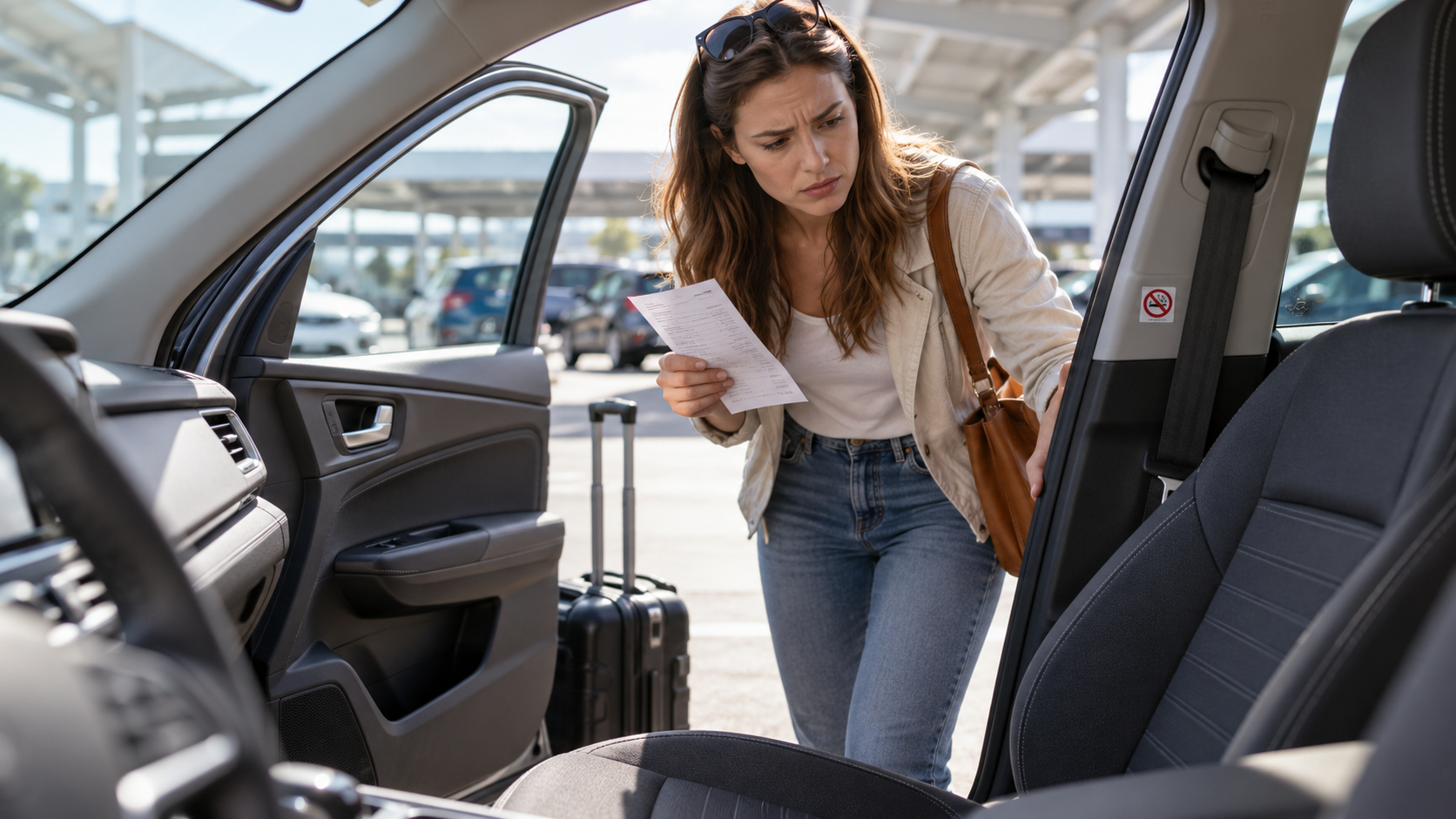
What to request, what your photographs can actually show, and how to document a smoke smell before your next rental begins.
You return your rental car, collect your luggage, and head home. Then an extra charge appears: a smoking fee.
You did not smoke. Nobody in your group smoked. Now you are being asked to explain something you say never happened.
To dispute a rental car smoking fee, request the exact policy, the inspection records, and the evidence linking the allegation to your rental. Submit your response in writing, preserve your pickup communications, and ask your card issuer about applicable dispute deadlines.
There is one important limitation: a photograph can show visible ash, litter, stains, or burn marks. It cannot record a smell. A useful dispute therefore combines the photographs with a clear timeline and any reports you made when collecting the car.
This guide explains how to build that record without assuming every charge is wrong—or that every accusation is justified.
What Is a Rental Car Smoking Fee?
A smoking fee is a charge linked to a rental company’s non-smoking policy. It is not necessarily the same as a general cleaning charge for mud, rubbish, or a spill.
For a concrete example, Avis’s published U.S. smoking policy states that a cleaning fee of up to $450 may apply when its policy is violated. It describes inspection and management review procedures, including circumstances where a car is inspected after the customer has left. That is one provider’s U.S. policy, not a universal price or process. Avis | Rent a Car
Start by identifying the charge on your own invoice. Does it say smoking, vaping, excessive cleaning, odor removal, or damage? Ask the company to clarify when the label is vague.
Challenge the specific allegation, not a different fee you found discussed online.
Why “I Don’t Smoke” Is Only the Beginning of Your Response
Saying that you do not smoke is relevant, but the company may be alleging something about the vehicle or its occupants rather than your personal habits.
Describe what you actually know. For example: “Neither I nor my passengers smoked or vaped in the vehicle during this rental.” Use that statement only when it is accurate.
Then connect your account to the rental’s timeline. Did the car already smell when you collected it? Did you tell an employee? Was the vehicle exchanged? Was anyone present at return?
Those details make your response more useful than an unsupported denial. Equally, a company’s statement that a car required cleaning leaves reasonable questions about what was observed and when.
The aim is to resolve a particular claim, not prove that your entire trip was uneventful.
How to Dispute a Rental Car Smoking Fee
1. Save the Notice and Identify the Exact Charge
Save the invoice, rental agreement, original email, and relevant payment entry. Record the amount, currency, rental reference, vehicle registration, pickup time, and return time.
Keep any response deadline visible. Separate the disputed smoking fee from the undisputed rental cost so your complaint clearly identifies the amount at issue.
Create a short chronology before contacting support. A reviewer should be able to understand the sequence without searching through a long email chain.
2. Request the Evidence and the Applicable Policy
Ask for the condition reports from pickup and return, photographs relied on, the time of the inspection, and the contract provision authorizing the charge.
Also ask what the company says was found: an odor, ash, burns, smoking materials, a recorded sensor event, or a combination of these.
Request the amount’s basis. Is it a contractual fee, an actual cleaning cost, or several items combined? Ask for the fee schedule or supporting assessment that applies to your booking.
These are requests for clarification, not a guarantee that every internal document must be disclosed. European Consumer Centres Network guidance recommends written rental complaints and requests for explanations and supporting evidence. Европейская сеть потребительских центров
3. Compare the Evidence With Your Pickup Record
Look through your original photographs and messages. Pay particular attention to anything recorded before you left the pickup location.
If the allegation concerns ash in a cup holder, check photographs showing that area. If it concerns a burn on a seat, look for a matching mark in the pickup images.
Be careful with uncertain details. A pale speck is not automatically ash; a dark mark is not automatically a cigarette burn.
Keep the originals unchanged. You can send a separate annotated copy to identify a location, but explain what your image shows rather than presenting an interpretation as an established fact.
4. Establish When the Vehicle Was Inspected
Ask when the condition was first recorded and whether the vehicle was moved, cleaned, or accessed between your return and that inspection.
Compare those times with your return receipt and other records. If a report uses a different time zone, request clarification before claiming the times are inconsistent.
A later inspection does not automatically invalidate a charge. Avis explicitly describes situations where inspection occurs after departure. The useful question is how the company connected its finding to your rental. Avis | Rent a Car
5. Send One Organized Written Dispute
State the charge, explain why you disagree, identify your evidence, and request a review.
Use descriptive filenames such as “pickup-front-seats” or “message-to-branch-at-collection.” Refer to the most relevant attachments in the body of your email.
Avoid unsupported accusations about previous customers or staff. If you do not know how an odor arose, say so. You can contest the evidence without inventing an alternative explanation.
Ask for a written decision that addresses the points you raised—not just another copy of the original invoice.
Rental Car Smoking Fee Dispute Email Template
Subject: Dispute of Smoking Fee — Rental Agreement [Number]
Dear Customer Service Team,
I am disputing the smoking-related charge of [amount and currency] associated with rental agreement [number].
I collected vehicle [registration] on [date and time] and returned it on [date and time]. Neither I nor my passengers smoked or vaped in the vehicle during the rental. [Include this sentence only if accurate.]
Please provide the pickup and return inspection records, the inspection date and time, the evidence supporting the allegation, and the policy or agreement provision used to calculate the charge.
[Where applicable: I reported an existing smoke smell at collection. The attached message records that notification.]
I have attached [describe the relevant records]. Please review this evidence and explain how the finding was attributed to my rental.
I request removal of the charge if the review does not support it, and a written explanation of your decision.
Kind regards,
[Name]
[Rental agreement number]
Remove every sentence that does not match your experience. Do not claim that you reported an odor or have photographs unless you actually did.
What If the Company Says a Sensor Detected Smoking?
Some vehicle-monitoring products include smoking detection. Bosch describes RideCare as a sensor-based service that reports smoking events and allows information to be viewed in a dashboard and consolidated for particular periods. Bosch Mobility
That does not mean every rental vehicle has such a system, or that every smoking charge uses it.
If a sensor report is cited, ask for the report used in your case. Check the vehicle identifier, event date, time zone, and rental period. Ask how the recorded event was interpreted and whether other inspection findings supported the decision.
Do not dismiss a report solely because it was automated. Equally, do not assume a label on an invoice answers every question about its supporting evidence.
Avoid copying technical arguments from Reddit about how a sensor must behave. Without appropriate evidence, an alternative explanation remains a possibility—not a demonstrated cause.
What If Your Rental Car Already Smells Like Smoke?
Report It Before Driving Away
Ask an employee to inspect the cabin and record the concern. Request a replacement when the vehicle is unacceptable to you, and keep any response in writing.
Avis’s U.S. guidance recommends inspecting the vehicle before departure and raising dissatisfaction with an agent; it describes providing another car when one is available. Turo also tells guests to report a smoke smell immediately at check-in. Follow the procedure for your actual booking. Avis | Rent a Car
A useful message is:
“Before leaving the pickup location, I noticed a smoke smell inside vehicle [registration]. Please record this existing condition and advise how to proceed.”
Record Visible Condition Separately
Photograph the seats, mats, cup holders, console, and any visible marks you are concerned about. Retain the original files and the written odor report together.
Do not present those pictures as proof that a smell existed or was absent. They document a different part of the condition.
If the vehicle is exchanged, keep the paperwork identifying both cars. Inspect the replacement rather than assuming the first inspection applies to it.
Ask for Specific Acknowledgment
“Don’t worry about it” is difficult to interpret later. Ask whether the existing odor has been recorded against the correct vehicle and agreement.
Make your own dated note of a conversation, including the location and what was said. Distinguish that personal note from written confirmation supplied by the company.
What If the Rental Company Rejects Your Complaint?
Request the reason in writing and check whether the response addresses your evidence. Ask for the company’s escalation route if the explanation remains incomplete.
Contact your payment-card issuer promptly about any available dispute procedure. Describe the transaction accurately: contesting an additional fee is not the same as saying your card was stolen.
For U.S. credit-card billing errors, the Consumer Financial Protection Bureau explains the importance of sending written notice within 60 days after the issuer sent the statement first showing the error. That rule should not be assumed to apply to every card or country. Ask your issuer which process and deadlines apply to you. Consumer Financial Protection Bureau
For eligible European cross-border rental complaints, a European Consumer Centre may be able to help. A refund or chargeback is not guaranteed, and a payment dispute does not by itself resolve every contractual disagreement. Европейская сеть потребительских центров
Where CarSeal Helps—and Where It Cannot
CarSeal helps renters create an organized photographic record of the vehicle at pickup and return. Its guided exterior workflow and comparison tools are intended to document visible condition, not certify the air inside the cabin. Its AI findings require review. carseal
For a smoking allegation, the most relevant records may be your written pickup complaint, inspection notes, and any supporting interior photographs captured separately.
CarSeal does not detect odors, certify that nobody smoked, or guarantee reversal of a cleaning fee.
Its role fits into a broader rental habit: document what you can see, report what you cannot photograph, and retain the acknowledgment.
Use CarSeal for your exterior pickup and return record, and preserve other evidence alongside it. The goal is an accurate record—not a promise that a single app can settle every dispute.
Frequently Asked Questions
Can a Rental Company Charge a Smoking Fee After Return?
Some providers’ procedures allow inspection and notification after departure. Avis describes this in its U.S. policy. The timing alone does not establish whether a particular charge is justified; request the records supporting it. Avis | Rent a Car
Can Photos Prove That Nobody Smoked?
No. Photos can document visible condition at particular moments, but they cannot record an odor or continuously establish what happened during a rental. Use them alongside your communications and inspection records.
Does the Smoking Policy Also Apply to Vaping?
Check the agreement rather than assuming vaping is exempt. Avis’s published U.S. terms prohibit smoking and vaping in or immediately around the vehicle. Other providers’ wording may differ. Avis | Rent a Car
Can I Dispute the Fee Without Pickup Photos?
You can still request a review and provide whatever genuine records you have. Look for messages, inspection paperwork, return receipts, and relevant witness accounts. Be clear about missing evidence rather than trying to recreate it afterward.
Should I Claim the Entire Rental Was Fraudulent?
Do not describe the situation inaccurately. Identify the additional amount you contest and explain the actual disagreement. Ask your issuer how to categorize it and follow its instructions.
Before Your Next Rental, Make Two Separate Records
Create a photographic record of visible condition and a written record of anything a photograph cannot capture.
A scratch belongs in your pictures. A smoke smell belongs in a prompt, specific report. Keep both with the rental agreement and return documents.
If an unexpected fee appears, request the evidence, compare the timeline, and respond to the specific allegation. Clear records are more useful than assumptions about what must have happened.
Document the car. Report the concern. Keep the acknowledgment.
Their Inspection. Your Evidence.
Create your next exterior pickup-and-return record with CarSeal.
This article provides general consumer information, not individualized legal or financial advice. Rental policies and dispute rights vary by agreement and jurisdiction. CarSeal does not guarantee refunds or determine liability.